After Catastrophic Car Accident and 18 Surgeries, Photographer Rebuilds Life
By Rona Gindin, Editorial Contributor
Her whole life, Jenny Hautmann had dealt with challenges related to cystic fibrosis, cirrhosis of the liver and diabetes. After growing up in New Mexico, she moved with her parents to Orlando, and her hobby of taking photos of rocket launches eventually led to coveted credentials from NASA. She loved photography but worried about how to build her career.
“The littlest things were the biggest problem for me, and I was like, ‘What am I going to do with my life?’” recalls Hautmann, now 25. Those questions became trivial four years ago, after she was in a major collision while driving to the Space Coast to photograph a rocket launch.
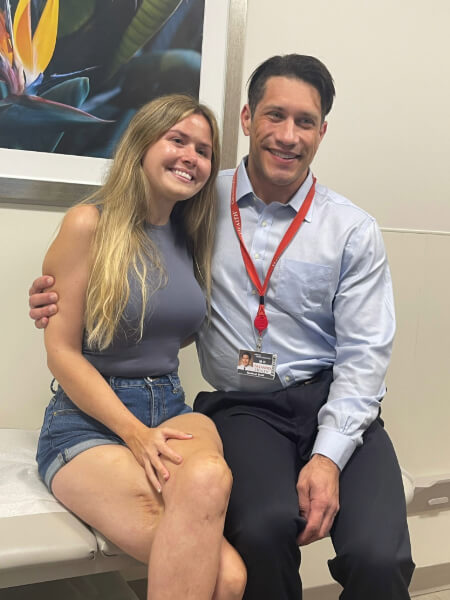
A rescue team cut Hautmann out of her car, and she was rushed by helicopter to Central Florida’s only Level One Trauma Center at Orlando Health Orlando Regional Medical Center. Doctors swooped in.
“I had broken both tibias, both femurs, multiple ribs, my pelvis, my jaw, my nose, two fingers, and the left side of my face,” she says. “The femur injuries were open fractures, meaning the bones stuck out of my body. My right heel had been completely ripped off, so the bone was exposed at the back of the foot. Also, both my lungs had collapsed and my spleen had ruptured.” She was, she later learned, “literally dying of internal bleeding.”
Dr. Matthew Lube, a general surgeon, removed her spleen and put a breathing tube into her neck, necessary because her mouth was wired shut. Dr. Frank Avilucea, a fellowship-trained orthopedic trauma surgeon, put her bones back in place.
This was a complex case even for veteran surgeons.
“The combination of bilateral long-bone fractures and an open fracture with segmental bone loss creates enormous complexity,” Dr. Avilucea says, noting that Hautmann’s injuries put her at “extremely high risk” of limb loss. “It requires staged reconstruction, infection control, soft-tissue management and precise alignment. This was not a single operation, but a carefully planned sequence to restore stability, reconstruct the region of bone loss and preserve the limb.”
Family Steps Up
Unable to walk or take care of herself, the fiercely independent Hautmann had to rely on her parents, Susanne and John, for every need. They set up a hospital bed in the house and retired early to become their daughter’s round-the-clock caretakers. That included managing everything from bedpan duties to bringing her to physical therapy so she could relearn how to walk.
Once the initial injuries healed, Hautmann struggled to walk more than half a mile at a time, a huge step toward returning to the life she’d lost. At the end of 2023, Dr. Avilucea conducted “the big surgery.” The procedure involved using an internal implant, along with bone graft preparation as part of a staged bone-regeneration technique, to restore alignment, stability and bone reconstruction of her leg.
Although the surgery was successful, Hautmann was required to remain non-weight-bearing on one leg for six weeks, requiring another prolonged period of rehabilitation. As part of her recovery, Dr. Avilucea performed two procedures known as manipulation under anesthesia, or MUA, to address postoperative knee stiffness. These procedures helped release scar tissue that was limiting her ability to fully extend and bend her leg.
Hautmann returned in May 2024 for one final operation — her 18th surgery overall. During that procedure, Dr. Avilucea replaced much of the existing internal fixation with more robust hardware and performed a biologic procedure to stimulate bone healing and regeneration, completing the staged reconstruction. “Every step forward felt like 10 steps back sometimes,” she says. “It was so difficult.”
Living Her Best Life
Hautmann had to learn how to walk a third time but has made major progress. “On good days I’m walking almost two and a half miles without stopping,” she says. “I can stand for over an hour. I can even manage a bit of a jog or a run. I have arthritis in my foot and tendonitis in one knee, and I’ll need other surgeries such as hip and knee replacements in the future, but I’m good.”
The person I was before the accident died that night. I had to learn to build a new person from ground zero.— Jenny Hautmann
Physical therapy discharged her — after a total of 250 hours, and she currently no longer requires routine follow-up with Dr. Avilucea.
“I have seen hundreds of doctors in my life because of the cystic fibrosis and liver cirrhosis and never shed a tear until Dr. Avilucea,” Hautmann says. “He invested so much into my case.”
Dr. Avilucea sees Hautmann’s progress as a big success. “It highlights what is possible when advanced surgical techniques and a motivated patient come together,” he says. “Today, we have the tools to salvage limbs in injuries that once meant permanent disability.”
Despite the extensive damage from head to toe, some good did come of this tragedy. People with cystic fibrosis often struggle to breathe due to thick mucus clogging their lungs. “When my lungs collapsed, it shook out all the mucus. My breathing has been a lot clearer since,” Hautmann says.
In addition, her spleen had been the size of a football (most are fist-sized) because of the cystic fibrosis. Spleens aren’t essential organs, and her ruptured one has been removed. In the hospital, gastroenterologist and hepatologist Dr. Arvind Murali switched Hautmann’s liver medication; now her numbers are significantly better.
For a time, Hautmann used her social media pages to document her medical journey. Now she’s back to work, photographing Space Coast happenings, but with two big changes: She avoids driving at night whenever possible. And she doesn’t drive anywhere near where the accident occurred.
Following the accident, some friendships shifted due to a temporary loss of independence during her recovery, but she has created new relationships as well as tighter bonds with her family, including sister Julia and brother Joey.
“I have never been happier than I am now. The person I was before the accident died that night. I had to learn to build a new person from ground zero.” She has nightmares, flashbacks and panic attacks but has learned to manage them effectively. Hautmann even flies abroad periodically to vacation.
“I gained back the weight I’d lost,” Hautmann says. “I started going to the gym and eating well. I’ve made myself more talkative when I go out in public. When I look in the mirror, I actually love who I am looking at, finally.”
If you spot Hautmann around town, you’re bound to notice her severely scarred legs. “I wear my scars with such pride,” she says. Today, the confident young woman wears shorts on all but the coldest days. “And I consider Dr. Frank Avilucea the artist behind them,” she says.
 Why Do I Have Electric Shock Pain in My Face?