Knee Injuries Threaten To End Teen Soccer Player’s Budding Career
By Rona Gindin, Editorial Contributor
High school sophomore Fabricio Mendez Diaz was in a competitive soccer game when he jumped up to hit the ball with his head and suddenly found himself on the ground. His torso was facing one direction and his legs -- one with a badly twisted knee -- the other. He couldn’t stand on the injured leg.
At 15, the ambitious Orlando City Soccer Network youth team left-winger had to question whether he’d ever be able to pursue his passion again.
A Lifelong Soccer Enthusiast
Fabricio had always played soccer; it has been his sole hobby as long as he remembers.
“I started at 3 years old and got serious at 13 or 14,” he says, adding that he hopes to go to college on a soccer scholarship. The sport is a family interest; his brother plays, too and his father is still on the field recreationally in what Fabricio jokingly calls “a really old league.”
Fabricio’s schedule was packed: school, homework, soccer practice — five days a week. Weekends involved games, always cheered on by his grandmother, parents and brother.
At first, Fabricio had no idea how serious his injury was. In fact, he hopped off the field on his uninjured leg. After a day or two of rest, the restless young man began jogging, jumping and generally acting like the athletic teenager that he was. His parents weren’t so cavalier: They insisted he visit the Orlando Health Jewett Orthopedic Institute — Randal Park.
The Medical Journey Begins
An MRI of Fabricio’s injured leg showed two serious issues: a torn meniscus and a non-contact fully torn ACL, technically an anterior cruciate ligament.
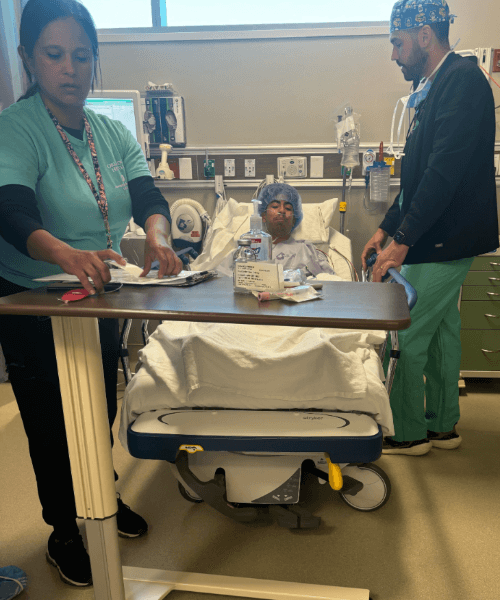
“We’re going to find you a surgeon right away,” a doctor said. A week later, Jewett sports medicine orthopedic surgeon Dr. Andrew Carbone performed a two-hour procedure to repair the meniscus and ACL.
It was a tough stage of my life, but it doesn’t feel like I tore my ACL anymore. I feel amazing.- Fabricio Mendez Diaz
“This was a really, really bad meniscus tear,” Dr. Carbone says. The operation involved repairing the lateral meniscus by flipping it, pushing it back into place, then stitching it in tightly so it won’t move. Once that was done, Dr. Carbone restructured the ACL.
There was no hopping Fabricio’s way into this recovery. Instead, the always-active student faced the reality that he’d be off his feet completely for six weeks and on a soccer hiatus for nine to 12 months. “That’s the only thing I had on my mind — get back and play soccer,” Fabricio says.
He’d been unable to go near a ball since the day he learned he’d need surgery and was still banned from participating in any athletics once the operation was complete.
Always focused, Fabricio rechanneled his energies toward healing, doing rehab for three months, then physical therapy five days a week. “It was like my soccer training sessions. First I learned how much I was able to use my leg. Then I got actual exercises and learned how to walk again, which was tough for me. I did this for nine months because I just wanted to recover as fast as I could, then get back and play,” says Fabricio, now 16.
Dr. Carbone was impressed with his efforts. “Fabricio really went above and beyond in terms of his rehab,” he says. “He worked hard and he really killed it.”
Getting Back to the Game
In both youth and professional sports, it’s challenging to assess exactly when athletes can safely return to their sport. “You know they’re going to be running and cutting and pivoting at some point,” Dr. Carbone says, yet the final green light involves educated guesswork. “We might take strength checks and say, ‘You look good; I think you’re ready to go.’”
At the Jewett Rehabilitation and Sports Medicine Center — Randal Park, the PT team took Fabricio’s assessment one step further. They tested his progress with a device called a DARI Motion machine, which analyzes how a body performs various movements, in part using 3D images in a way the naked eye can’t. They ran Fabricio through a series of sports-related moves, then actually assessed the risk of re-tearing the ACL based on his body.
“It gives us accurate, quantifiable, objective data” to see when a player can return to sport,” Dr. Carbone explains.
There’s a bonus — patients can’t blame doctors for being too cautious, since the decision is entirely fact-based. “If you know that risk of re-tear is 20 percent if you go back now, but down 50 percent more if you wait two months, you’ll wait,” Dr. Carbone says.
For Fabricio, after nine months the machine showed he wasn’t ready for a return. He took the test again two months later and was cleared. Less than a year after his misguided header and subsequent surgery, he returned to his team.
Now a high school junior, Fabricio is back on the soccer field and looking forward to a bright future.
“It was a tough stage of my life, but it doesn’t feel like I tore my ACL anymore. I feel amazing,” Fabricio says.

 Why Do I Have Electric Shock Pain in My Face?