Overcoming ‘Macho’ Mindset: Early Colonoscopy Detects Colon Cancer
By Melanie Ave, Editorial Contributor
Jason Jose spends his career telling other people's health stories and organizing medical conferences for Orlando Health. But when it came to his own preventive care, he was a classic procrastinator.
He was 47 and two years overdue for a routine screening colonoscopy. Colorectal screenings are recommended beginning at age 45 for those with no family history of colorectal cancer.
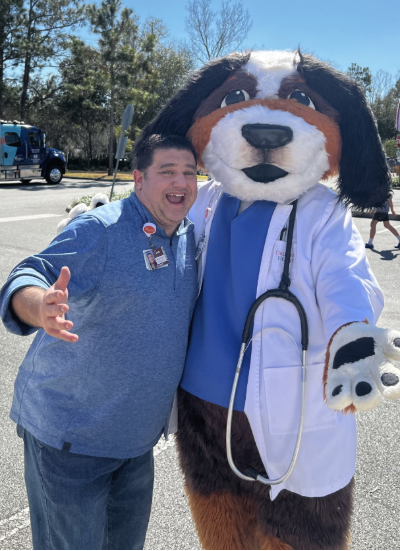
Jose had lots of excuses to avoid scheduling an appointment.
“I had no symptoms,” said Jose, now 48. “And I had that macho man feeling that I didn’t need it, you know?”
Enter Jose’s friend and colleague, Orlando Health Digestive Health Institute gastroenterologist Dr. Udayakumar Navaneethan.
He encouraged Jose more than once to get a screening. Nothing moved him to schedule an appointment until Dr. Navaneethan brought out the tough love.
“I told him, ‘I'm not going to talk to you until your colonoscopy,’” he finally told Jose.
Why You Need a Colonoscopy at Age 45 — Even Without Symptoms
In recent years, Dr. Navaneethan has seen an uptick in the number of young people diagnosed with colon cancer, which he attributes to diets filled with too much processed food and lifestyles with too little exercise. Colonoscopies, he said, “prevent cancer, not just detect cancer.”
I had no symptoms. And I had that macho man feeling that I didn’t need it, you know?— Jason Jose
Colorectal cancer is the second-leading cause of cancer-related deaths in the United States, according to the American Cancer Society. Although overall rates are declining, cases among adults under 55 are increasing.
Early detection through recommended screenings is critical, with survival rates exceeding 90% when the disease is found early.
Knowing the statistics, Dr. Navaneethan worried about his stubborn colleague.
From Delay to Diagnosis: Catching Colon Cancer
Jose, a married father of two grown daughters, has worked in the healthcare field for nearly 20 years. He has spent the past 13 years working alongside the physicians and staff at the Orlando Health Digestive Health Institute.
To him, the doctors are close friends, family almost.
As the event manager for the institute, Jose plans educational and marketing events, routinely helping promote colorectal cancer awareness and screenings.
The irony that he avoided a screening is not lost on him.
After Dr. Navaneethan laid down the law to Jose, he arranged a colonoscopy for Jose at Orlando Health Dr. P. Phillips Hospital.
After the procedure — what Jose calls the “the best nap ever” — he waited to see his doctor.
“Dr. Navaneethan and I, we joke around, we laugh and whatever,” Jose said. “But when I saw his serious face coming in, I was like, ‘Uh oh. Something is happening here.’”
“I told him, ‘Unfortunately we have cancer, but even better news, we actually found [it] early,’” Dr. Navaneethan said. “It could be completely cured by surgery.”
The screening found three cancerous polyps. The diagnosis: stage 2 colon cancer.
Neither the patient nor the doctor wanted those results. But Dr. Navaneethan was thankful the colonoscopy that he urged Jose to get detected the cancer early.
“If he had delayed it by another six months to a year,” Navaneethan said, “I think it could have been stage three or four … and a completely different story.”
Surgery and Chemotherapy: Treating Stage 2 Colon Cancer
The shock of the diagnosis set in during Jose’s drive home that spring day, especially with his father also battling advanced prostate cancer. (Jose's father tragically passed away while Jose was dealing with his own cancer diagnosis.).
Within days, Jose had an appointment with Dr. Marco Ferrara, a colon and rectal surgeon with the Orlando Health Colon and Rectal Institute. During the surgery, Dr. Ferrara performed a 12-inch resection and removed the affected portion of Jose’s colon.
Post-surgery scans confirmed the cancer hadn't spread to Jose’s lymph nodes, liver or lungs.
“It was like this big old rock on my shoulder just came off, you know, knowing that the lymph nodes were all negative,” Jose said.
Following the surgery, Jose chose a four-month, four-treatment chemo regimen to eliminate the possibility of stray cancer cells in his body. Without the treatment, he had a 60% to 70% chance of the cancer returning within 10 to 15 years. But with the treatment, the odds of a recurrence dipped to 5%.
To Jose, it was a no-brainer.
Despite the chemo treatment’s side effects — numbness to cold temperatures, some fatigue and temporary dietary adjustments — Jose maintained a relentless normalcy. He worked through his treatments, attended Orlando City soccer games and leaned heavily on his Catholic faith and family support.
“I’m a fighter,” Jose said.
Break the Stigma: Getting Screened Is the Real 'Macho' Move
Jose now has a renewed passion for promoting colorectal screenings. He uses his own cancer story to strip away the stigma, the embarrassment and the “macho man” hesitation surrounding the procedure.
His experience has already inspired friends, his older brother and a doctor-skeptical cousin to schedule their own screenings.
Jose recently rang the bell to celebrate his final chemotherapy treatment.
His thoughts are now on the future. He is looking forward to good health and a pilgrimage with his family to the Shrine of Our Lady of Fatima in Portugal, the country where his parents emigrated from in the 1970s.
More importantly, Jose now shares his own story as a way to warn others not to put off their health.
His message is clear: Colorectal cancer screening is easier than you might think, and early detection can make a difference.
“Be a macho man and do it,” Jose said. “Get your colonoscopy done.”
This content is not AI generated.
