Relieving Chronic Pain: Minimally Invasive Surgery Treats Giant Uterine Fibroids
Rona Gindin
First, Evelyn Pacheco’s abdomen was uncomfortable. Over time, it hurt so badly she’d be nauseated and get days-long headaches. “It’s menopause,” her nurse practitioner told her repeatedly over several years.
The pain kept getting worse.
When Pelvic Pain Isn’t Menopause
“It was a nightmare to find out what was wrong,” says Pacheco, now 54. A high-energy manager of podcasts and radio broadcasts for a media company, Pacheco tried to ignore the pain while juggling work projects, long-distance hiking, Pilates exercises and visits with her adult children.
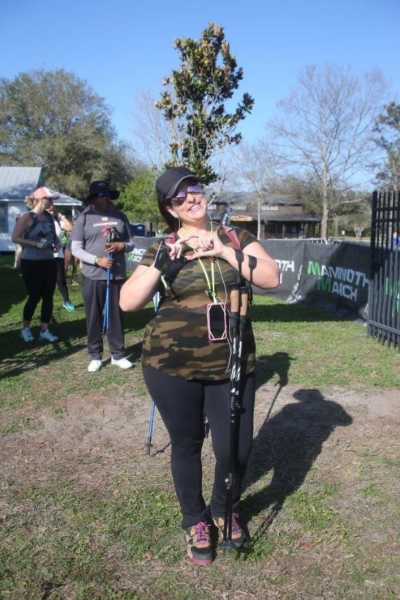
She mentioned the nearly unbearable pain to a customer with whom she had developed a friendship. That woman urged Pacheco to have a full body CT scan at the imaging center where she works. The scan revealed signs of trouble. “Something is going on in that abdomen of yours,” she was told.
Pacheco got in to see an OB-GYN that day. “The doctor touched my abdomen for two seconds and said, ‘Oh, you’ve got fibroids here, here, here, here, here, here and here,’” she says.
He recommended a hysterectomy and referred her to Dr. Jed Schortz, a gynecological surgeon at the Orlando Health Women's Institute Center for Minimally Invasive Gynecologic Surgery.
By the time she had an ultrasound a couple of weeks later, Pacheco felt desperate. “I was knee-deep in pain.” For good reason.
“The imaging showed everything inside me scrunched together,” she says. “I had one fibroid the size of a newborn’s head, one a little smaller and a bunch of others of varying sizes. No wonder I’d have trouble going to the bathroom — one and two!” As it turns out, her “massively enlarged,” fibroid-filled uterus weighed close to 3 pounds, Dr. Schortz found. A typical uterus weighs about 2 ounces.
Treating Large Fibroids with Minimally Invasive Robotic Hysterectomy
Dr. Schortz ordered an MRI to see even more detail, then concluded a full hysterectomy was the best option. That involves removing not just the uterus and cervix, which is a more common procedure. Pacheco decided to have her ovaries and fallopian tubes taken out too so her fibroid problem would end for good.
Initially when I thought about losing my organs I was like, ‘Argh!’ then I was like, ‘Get over yourself’ and that was that.— Evelyn Pacheco
A full hysterectomy is a big surgery, and Dr. Schortz promised to try to perform it robotically and laparoscopically. That means that instead of cutting open her abdomen, as in traditional surgery, he’d make a few small incisions, fill her insides with gas and use miniature cameras to get a good view of her organs to remove them safely using advanced robotic equipment.
“This is less invasive with less risk for complications like infections,” Dr. Schortz says. “There is less blood loss, and the patient can return home the same day.”
Dr. Schortz and his staff made sure Pacheco understood the entire process.
“Dr. Schortz took time to answer whatever I asked, and I never felt rushed. Also he and his whole team spelled out every single step so clearly that I always knew what was going to happen next,” she says.
“We only do gynecological surgery,” Dr. Schortz explains. “We have it down to a science. In meetings with the doctors and the pre-op nursing staff, we go through all the details of the procedure and what the expectations on recovery should be,” he says, noting that handouts confirm those details. “We usually provide prescriptions beforehand. Then the hospital repeats much of that after the surgery.”
Pacheco booked her surgery for the end of August, seven months after that first CT scan. She was excited that her pain would end but concerned about a temporary ban on many activities – no strenuous labor for up to eight weeks and sexual activity for 12.
“I’ll be depressed with no work and exercise. You may as well just prescribe me lithium or antidepressants during recovery,” she joked with her care team.
Healing and Eager for a Pain-Free Life
After the four-hour procedure, which, as promised, Dr. Schortz did laparoscopically and robotically, Pacheco returned to her College Park home the same night.
She tasked her boyfriend with keeping Dixie, a feisty chihuahua described as “10 pounds of fury” away from Pacheco for two weeks. Her parents, who came from Pacheco’s hometown of Miami to tend to their daughter and the housework, cooked up healing meals.
She left the hospital wearing a hospital band and was told to leave it on for a few days. “I called it my festival pass” she laughs. “I was told to call an ambulance if I have excessive bleeding. The EMTs would scan the bracelet and know to send me to Orlando Health Winnie Palmer Hospital for Women and Babies,” which has her chart. Luckily, she never needed it.
The physical and emotional pain was challenging but it passed quickly. “Initially when I thought about losing my organs I was like, ‘Argh!’ then I was like, ‘Get over yourself’ and that was that.”
Seven weeks post-surgery, Pacheco was cheerful and eager to get moving again. She is grateful at the prospect of having no abdominal pain.
“The whole team gave me clarity every step of the way,” she emphasizes. “I want to understand what’s happening, and they had all the information laid out for me.
While still healing, she planned a December vacation to North Carolina. She has her hiking boots ready.
