

About the Atrial Fibrillation (AFib) Program at Orlando Health Heart & Vascular Institute
More than three million Americans are currently living with atrial fibrillation (AFib). AFib occurs when there is a problem with your heart's electrical system. A healthy heart uses electrical impulses to pump blood through your heart and to the rest of your body. When you have AFib, these impulses become irregular, causing your heart to beat too fast and out of sync. AFib can impact your lifestyle significantly, making it difficult to perform daily tasks. Research indicates that the sooner you get treatment for AFib, the better the long-term outcome for you.
The care team at the Electrophysiology and Arrhythmia Center at Orlando Health Heart & Vascular Institute focuses on treating patients with irregular heartbeats — including AFib. AFib now has more treatment options than ever before. Our experts work together to customize the most effective treatment plan for your needs. The plan may include medicine, corrective surgery, implantable devices or a combination of treatments. We have seen thousands of patients with chronic (constant) and paroxysmal (comes and goes) AFib.
If you suffer from chronic (ongoing) AFib or AFib that is difficult to treat, we have the expertise and experience that allows us to provide innovative treatment options to treat your irregular heartbeat successfully. If you have been diagnosed with AFib, we are here to give you a second opinion and help you find a treatment solution.
Orlando Regional Medical Center is the only hospital in Central Florida and one of only two hospitals in the state of Florida to have full accreditation from the Society of Cardiovascular Patient Care for its Atrial Fibrillation Program. Our experience and knowledge, combined with a compassionate team, provides you with the highest quality care.
Atrial Fibrillation (AFib) Locations
We have outpatient locations throughout Central Florida. Experts recognize out hospitals for high-quality heart failure treatments.

Meet the Advanced Heart Failure Team
Our care teams has experts from multiple medical disciplines including advanced heart failure specialists, cardiologists, advanced practice providers, nurses, social workers and pharmacists.
New AFib Treatments
Catheter-based cryoablation
This type of cardiac ablation uses cold energy to scar and destroy tissue in the heart to disrupt faulty electrical signals causing the irregular heartbeat. The cold energy is released through a catheter or a small tube inserted at the groin into an artery leading to the heart.
Radiofrequency ablation
This form of cardiac ablation uses heat energy to scar and destroy tissue in the heart to disrupt faulty electrical signals causing the irregular heartbeat. The heat energy is released through a catheter or a small tube inserted at the groin into an artery leading to the heart.
Hybrid-maze ablation procedure
This minimally invasive surgical treatment, done in two stages, combines the best of electrophysiology and cardiac surgery treatments to help restore a normal heart rhythm. In the first stage, without actually opening the chest, the surgeon uses radiofrequency waves to create specific scar lines on the heart's surface to destroy the electrical signals that cause the heart to beat irregularly. In the second stage, a cardiac electrophysiologist performs catheter ablation using cold or heat energy to create more scars inside of the heart. This procedure reverses AFib by putting the heart backinto rhythm while offering a quick recovery.
Traditional maze procedure
The surgeon creates a maze-like pattern of lesions on the surface of the heart to channel the heart's natural electrical signals to regulate the heartbeat.
Left atrial appendage closure procedure (LAAC) The WatchmanTM Device Implant
This procedure reduces the risk of stroke in people with non-valvular atrial fibrillation (AFib not caused by heart valve problems). This is an option for AFib patients who cannot be treated with the blood thinner warfarin due to bleeding concerns. In this minimally invasive procedure, the physician places the Watchmano Implant to close the left atrial appendage in the heart, preventing the possibility of stroke by stopping potentially harmful blood clots from entering the blood stream and traveling to the brain.
Get Your Free AFib Information Guide
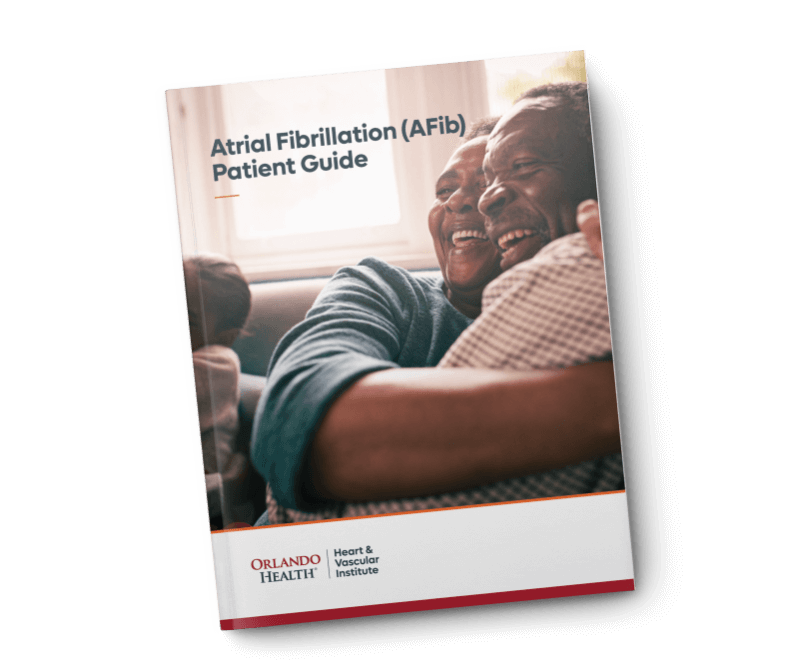
Learn more about the symptoms of AFib and healthy habits that can help manage your AFib. Discover available options for permanently treating your AFib and restoring the healthy function of your heart’s electrical circuits. Fill in the form at right to download your free guide.
Navigate Your Health

Find a Heart & Vascular Physician
Find a Heart & Vascular Physician
Meet our doctors who specialize in the full range of heart and vascular care. Our team of experts has experience in a variety of specialty areas. Together, we provide comprehensive evaluation, diagnosis and treatment options.
Find a Doctor
Patient Portal
Patient Portal
If you are a patient at Orlando Health Heart & Vascular Institute, our free online patient portal provides an easy and secure way to manage your health information. Reach us from any location at a time that’s convenient for you.
Learn More
Virtual Visit
Virtual Visit
Need to talk with a doctor, but don’t want to leave your home? Try our virtual visit (telehealth) option to connect with a physician from your phone, tablet or computer.
Learn More